
IGNOU BCHCT-135- Solved Assignment
Are you looking to download a PDF soft copy of the Solved Assignment BCHCT 135 Solutions is the right place for you. This particular Assignment references the syllabus chosen for the subject of Hindi, English, for the Jul 25 – Jan 26, Jul 24 – Jan 25 session. The code for the assignment is BCHCT-135 and it is often used by students who are enrolled in the BSC (Honours), IGNOU CBCS Solved Assignments Degree. Once students have paid for the Assignment, they can Instantly Download to their PC, Laptop or Mobile Devices in soft copy as a PDF format. After studying the contents of this Assignment, students will have a better grasp of the subject and will be able to prepare for their upcoming tests.
PLEASE MATCH YOUR ASSIGNMENT QUESTIONS ACCORDING TO YOUR SESSION
IGNOU BCHCT-135 (January 2026 – December 2026) Assignment Questions
PART-(A)
1.Define the following terms:
(i) Molarity (M)
(ii) Molality (m)
(iii) Normality (N)
(iv) Mole fraction (x)
(v) Parts per million
Also give their units.
2.(a)State Raoult’s Law. Also, give its mathematical form.
(b)Give any two applications of solvent extraction.
3.(a)Draw and explain the mutual miscibility curve for phenol – water system.
(b)Discuss the effect of impurities on CST values.
4.(a)Define the following terms:
(i) Phase
(ii) Components
(iii) Degrees of freedom
(b)Write the integrated form of Clausius-Clapeyron equation. What were the two assumptions made by Clausius?
5.Draw and explain the phase diagram of water highlighting its important features.
6.(a)Define conductivity and give its units.
(b)The conductivity of a 0.1 M aqueous solution of acetic acid is found to be 5.3 x 10⁻⁴ S cm-1. Calculate the molar conductivity of acetic acid solution at the given concentration.
7.(a)Explain ionic mobility and give its units. Briefly explain the factors affecting it.
(b)List the applications of conductivity measurement.
8.(a) Draw the schematic diagram of a Daniell cell and give the reactions taking place at the electrodes.
(b) What are the functions of a salt bridge?
9.(a) Give an example of a concentration cell with transference.
(b) What is quinhydrone electrode? Give its advantageous and disadvantageous.
10.(a)Discuss any two applications of electrolysis.
(b)Briefly explain the process of electrolysis.
PART-(B)
11.Explain the mechanism of Fischer esterfication reaction.
12.(a) Arrange the different carboxylic acid derivatives in the decreasing order of their reactivity towards nucleophilic substituted reactions and give reason for your answer.
(b) What is Rosenmund reduction? Give an appropriate example for this reaction.
13.(a) Briefly explain the following reactions:
(i) Curtius rearrnagement
(ii) Schmidt rearrangement
(b) Write the products of reduction of nitrobenzene in basic medium under different conditions.
14.(a) What is diazotisation reaction? Give the products formed by the diazotisation of the following: (i) ethanamine (ii) benzenamine
(b)What is reductive amination? Give the product of the reductive amination of diazonium salt formed by 2,4,6-tribromoaniline.
15.Explain the products formed by the nitrosation reactions of primary, secondary and tertiary amines.
16.(a) How will you obtain valine using Gabriel phthalimide synthesis? Explain.
(b)How will you detect a 2-amino acid using ninhydrin?
17.Discuss Edman degradation of N-terminal identification of peptides giving suitable reactions.
18.Briefly describe the primary, secondary, tertiary and quaternary structures of the peptides and proteins.
19.(a) Write the Fischer projection of D-glucose. Also write the Haworth projections of –D-glucose and β -D-glucofuranose.
(b)Explain mutarotation using glucose as the example.
20.(a) Write the structures of β-lactose and sucrose with appropriate labelling.
(b) Differentiate between amylose and amylopectin.
IGNOU BCHCT-135 (January 2025 – December 2025) Assignment Questions
IGNOU BCHCT-135 (January 2024 – December 2024) Assignment Questions
PART-(A)
1. Discuss the fractional distillation for a mixture of benzene and toluene using a suitable diagram.
2. (a) Give the thermodynamic derivation of distribution law.
(b) Write any two applications of solvent extraction.
3. (a)Derive the expression for distribution coefficient when the solute dissociates is one of the solvents.
(b) Differentiate between true, metastable and unstable equilibria giving suitable examples.
4. (a) State Gibbs phase rule and give its mathematical form.
(b) How many components are there in the following systems? Briefly discuss.

5. (a) Calculate the maximum number of phases and maximum number of degrees of freedom that
(b) Can exist for a one-component system. When is a system called invariant? Illustrate with an example.
6. Draw and explain the phase diagram of sulphur
7. (a) Define conductivity. Give its SI units.
(b) List various factors on which the conductivity of electrolytic solutions depends.
8. Draw and explain the conductometric titration curves for the titration of the following:
(i) HCl vs NaOH
(ii) CH3COOH vs NaOH
9. (a) List the functions of a salt bridge.
(b) What are the conditions which a reversible cell should satisfy.
10. (a) What is an electrolyte concentration cell? Write the expression for Ecell for such a cell.
(b) Write the reactions occurring at electrodes in the electrolysis of water. Why are a few drops of conc. H2SO4 added in this process?
PART-(B)
11. Discuss the two methods of decarboxylation of carboxylic acids and comment on the nature of products formed.
12. How can you propane the following compound starting from ethanoyl chloride?
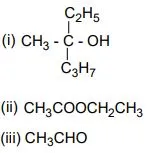
13. Briefly explain Hofmann elimination. Also give the importance of this reaction.
14. Differentiate between Sandmeyer reaction and Gattermann reaction giving suitable examples.
15. Discuss the Hinsberg test for distinguishing primary, secondary and tertiary amines.
16. (a) Discuss the preparation of 2-aminobutanoic acid using Strecker synthesis.
(b) What is cope elimination? Give reaction.
17. (a) Briefly explain this general structure and classification of peptides.
(b) What is bradykinin? Give its role?
18. How is C-terminal indentified in a peptide or a protein? Discuss.
19. (a) Explain the cyctic hemiacetal formation by glucose.
(b) Explain mutarotation in glucose.
20. Discuss the important features of structure of cellulose giving suitable diagram.
IGNOU BCHCT-135 ASSIGNMENTS DETAILS
| University | : | IGNOU (Indira Gandhi National Open University) | |
| Title | : | Solutions, Phase equilibrium, Conductance, Electrochemistry and Functional Group Organic Chemistry-II | |
| Language(s) | : | English, Hindi | |
| Code | : | BCHCT-135 | |
| Degree | : | BSCG | |
| Subject | : | Chemistry | |
| Course | : | Core Courses (CC) | |
| Author | : | ignouedumart.com Panel | |
| Publisher | : | Distance Gyan Publishing House Pvt. Ltd. |
Call us: +91 9466323363




Reviews
There are no reviews yet.